

Over the last several years, Deop has helped software companies migrate applications, modernize development platforms, establish secure Azure foundations, and improve how their engineering teams deliver software. That work is now entering its next chapter.
I'm pleased to share that Deop has deepened its relationship with Microsoft through three Microsoft specializations:
- Agentic DevOps with Microsoft Azure and GitHub
- Infra and Database Migration to Microsoft Azure
- Networking Services in Microsoft Azure
We're also participating in Microsoft's FY27 Frontier Accelerate for Azure partner-nominated program, which gives us more opportunities to connect eligible customers with Microsoft-supported assessments, proofs of value, and implementation engagements.
The important part of this announcement isn't the badges — it's what they let us do for our customers. Our deeper work with Microsoft isn't about adding another logo; it's about combining Deop's hands-on engineering experience with Microsoft's technology, programs, and potential co-investment to make AI adoption less risky. The goal is to give software companies one connected journey: from migration and governed cloud foundations to AI-assisted development and, eventually, supervised AI agents doing meaningful engineering work.
Three specializations, one connected journey
Each specialization recognizes a different part of our work, but software companies rarely experience these challenges separately. A company may begin by moving applications and databases to Azure. It then needs secure networking, identity, governance, cost controls, observability, and reliable deployment pipelines. Once that foundation exists, its teams can begin using GitHub Copilot, Azure AI Foundry, AI agents, and other capabilities in a secure, repeatable way.
That's why we see the three specializations as parts of one path: migrate, build the foundation, modernize software delivery, enable AI. Our migration specialization supports moving and modernizing applications and data on Azure; our networking specialization supports the secure, scalable foundations those workloads depend on; and our Agentic DevOps specialization brings GitHub, developer productivity, application security, automation, and AI-assisted engineering into the same transformation.
From cloud foundations to AI-enabled engineering
For the past few years, many organizations have treated cloud modernization and AI adoption as separate initiatives. We don't believe they should be. AI depends on the foundations underneath it: before a software company can operate AI safely in production, it needs clear identity controls, secure networking, protected data, auditable environments, cost visibility, reliable deployment, and development practices teams can follow consistently.
That's why our AI work often begins with an Azure or AI Foundry landing zone. A governed landing zone gives engineering teams an approved place to experiment and build — instead of every team creating its own accounts, API keys, security rules, and deployment process, the company establishes reusable patterns that can be adopted across products and business units.
From there, we help teams modernize the development lifecycle itself. That work can include:
- Migrating repositories and pipelines from Azure DevOps, GitLab, or Bitbucket to GitHub Enterprise
- Establishing GitHub governance, security policies, and reusable workflows
- Introducing GitHub Copilot through structured pilots and enablement programs
- Building secure CI/CD processes for AI applications and standing up production-ready Azure AI Foundry environments
- Preparing teams for agent-based development workflows
The objective isn't simply to give developers another tool. It's to improve how ideas move from a product discussion to secure, production-ready software.
A de-risked way to begin
One of the most meaningful benefits of our deeper Microsoft relationship is the ability to help qualifying organizations access Microsoft-supported engagements. Depending on program eligibility and approval, an engagement can begin with a funded or partially funded assessment and proof of value — a way to test an idea, validate the expected benefit, understand the technical requirements, and develop a realistic production roadmap before committing to a larger implementation.
For a company exploring GitHub Copilot, an assessment might identify where developers lose time, select teams and use cases for a pilot, define security and governance requirements, and establish baseline measurements. For an AI product idea, a proof of value might stand up the landing zone, test the proposed architecture, validate the data and model approach, and determine what's needed to run it reliably in production. It changes the opening question from "Should we make a large AI investment?" to "What can we validate first, and what evidence do we need to make the next decision?"
One partner for the full journey
Software companies often end up coordinating several providers — one for cloud migration, another for networking, another for GitHub, another for AI. That fragmentation creates delays and leaves gaps between platforms. Deop's direction is to be one connected team across the whole path: move and modernize applications and data, establish governed Azure and AI foundations, modernize repositories and CI/CD and developer workflows, introduce AI-assisted development with the right policies and training, and progress toward supervised agentic workflows where they create measurable value.
This matters most for vertical software groups and companies managing several products or portfolio businesses. Instead of building a different AI environment for each product, a company can establish a reusable platform with centralized governance and isolated environments per team — so the next product or portfolio company starts from a proven pattern rather than rebuilding identity, networking, security, and cost controls from scratch. We've recently put this into practice building the AI foundations for a vertical-market, AI-first marketing platform: a secure Azure AI Foundry landing zone, an automated development lifecycle integrated with GitHub, and the core AI capabilities themselves. An AI application can't succeed on model development alone — it also needs a governed platform, repeatable deployment, security, monitoring, and a lifecycle that lets teams improve the product safely after launch. That's the model we expect to apply across the software companies we serve.
Governance should make AI move faster
There's a common assumption that governance slows innovation. In our experience, unclear governance is what slows innovation. When teams don't know which AI services are approved, what data they can use, where workloads can run, or how an application will pass a security review, promising prototypes get stuck between experimentation and production.
Good governance answers those questions early. It gives developers secure environments, approved services, reusable workflows, clear ownership, and defined paths to production — so teams spend less time seeking exceptions or rebuilding controls and more time delivering useful capabilities. Governance isn't the brake on AI adoption. Done properly, it's the accelerator.
Moving from AI-assisted to AI-delegated work
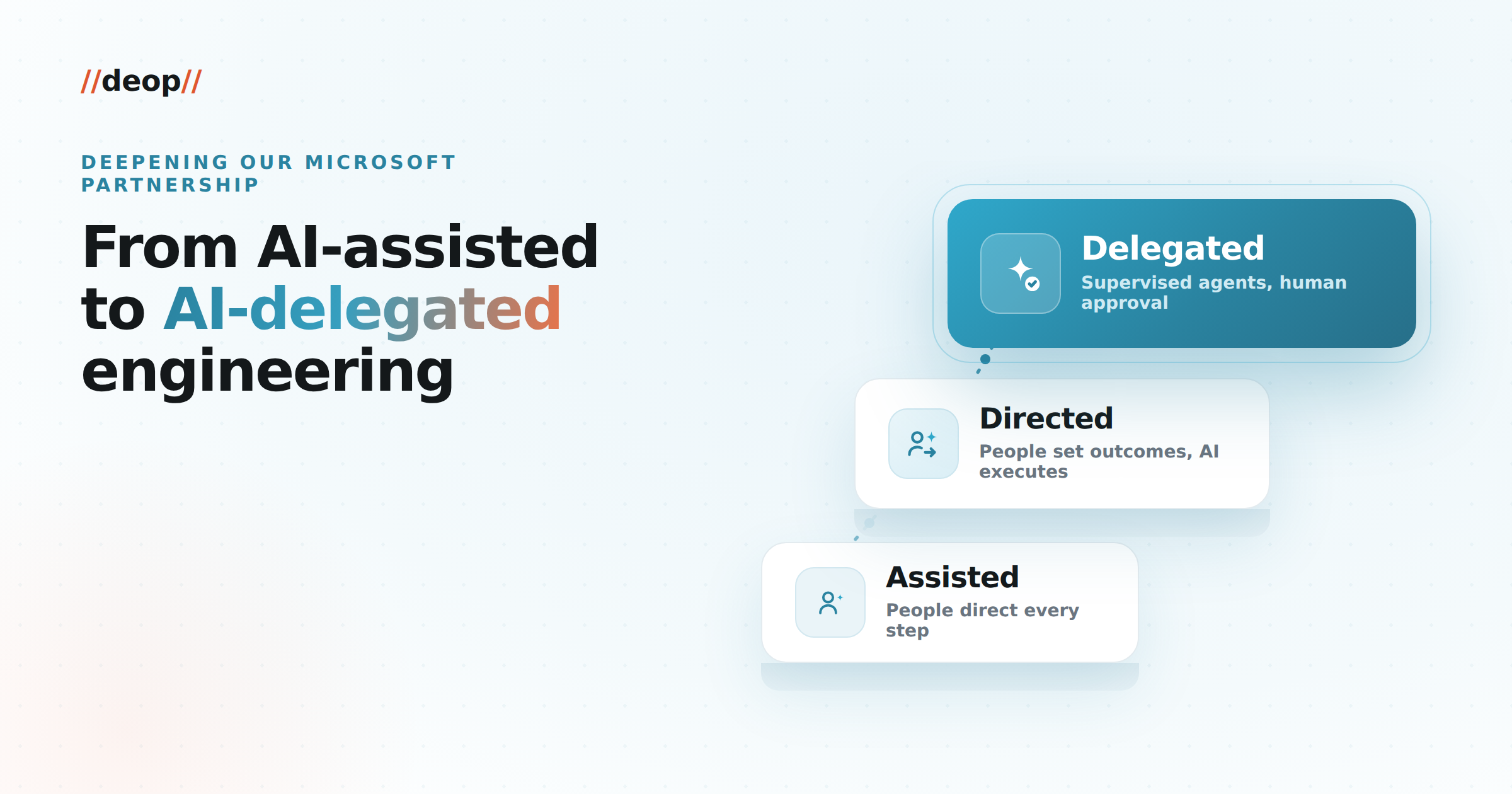
Most engineering organizations are still early in their AI journey. Developers may be using AI to explain code, generate tests, draft documentation, or suggest implementations — the AI-assisted stage, where AI helps a person complete a task but the person directs each step. The next stage is AI-directed: a person defines a larger outcome, and AI completes several connected activities while the person reviews decisions and results. Over time, selected workflows can become AI-delegated, where supervised agents perform defined engineering tasks within established permissions and policies and return their work for human review and approval.
This doesn't mean removing engineers from software development. It means letting them spend less time on repetitive work and more on architecture, product decisions, quality, security, and complex problem-solving. Moving through these stages safely takes more than a new AI model — it takes secure platforms, well-structured repositories, strong testing, observable workflows, clear approvals, and teams that know how to supervise AI-generated work. Those are the capabilities Deop is building with its customers today.
Where Deop is headed
We've spent years helping software companies modernize the platforms their products run on. The next chapter is helping them use those platforms to build with AI — securely, responsibly, and in production rather than only in demos. Our deeper Microsoft collaboration gives us stronger alignment across Azure, GitHub, AI platforms, and Microsoft-supported customer programs; our specializations give customers added confidence that our capabilities have been tested against Microsoft's requirements; and our experience working directly with software teams keeps the work focused on practical delivery rather than technology for its own sake.
The result is a clearer path from migration to modernization, from modernization to AI-assisted development, and from AI assistance to supervised agentic workflows. That's where Deop is headed — and where we want to take our customers next.
Deop helps software companies establish governed AI foundations, modernize their GitHub and DevOps workflows, and move from AI experimentation to secure production delivery — as a Microsoft partner across Azure, GitHub, and AI. Eligible organizations may also qualify for Microsoft-supported assessments and proofs of value. Explore our AI and Copilot enablement work or see how we approach cloud governance.