

Every software company we talk to wants to build with AI. The ones who move fastest — and safely — tend to start the same way: not with a model, but with a foundation.
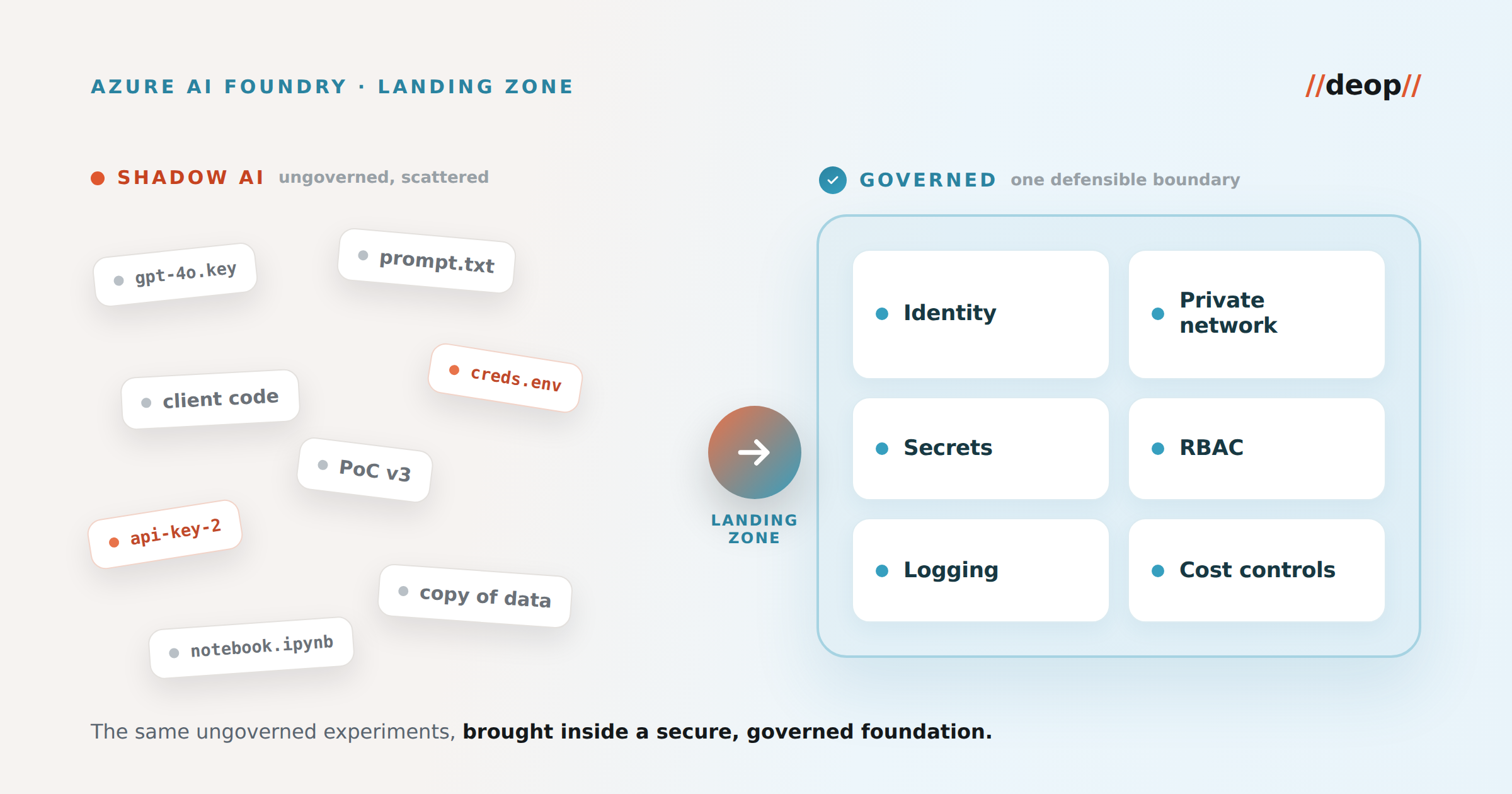
In most engineering orgs, AI adoption is already happening whether or not there's a plan for it. A developer wires up an API key on a personal account to prototype a feature over a weekend. A team pastes proprietary code into a consumer chatbot to debug it. It works, it's fast, and it's completely ungoverned — no identity, no network boundary, no audit trail, and no real record of what data just left the building. That's "Shadow AI," and it's the default state of any company that hasn't yet decided how it wants to build with AI.
An AI Landing Zone is that decision, made deliberately. It's the governed foundation you stand up before your first real AI workload, so that identity, networking, security, cost controls, and environments are already in place — instead of being bolted on after something goes wrong.
What an AI Landing Zone actually is
Here's the plainest definition we use: before any AI workload can run reliably in production, the platform underneath it has to be right. An Azure AI Foundry Landing Zone is a secure, governed, and scalable AI environment — built to enterprise standards from day one.
Put less formally, it's the difference between "someone spun up an OpenAI key on a credit card" and "we have a defensible platform we can scale." The landing zone is the second thing. It's pre-built and repeatable, so the first time a team wants to ship an AI feature, the hard platform questions — who can access what, where the data lives, how spend gets tracked — are already answered. Nobody is inventing governance in the middle of a launch.
AI moves fast. Governance is what makes sure it moves in the right direction.
The anatomy: what's inside one
A well-built AI Landing Zone on Azure AI Foundry rests on four pillars.
Security and governance. Role-based access control, private networking, identity management, and audit logging, so every AI workload runs inside a defined, defensible boundary. Identity is anchored in Microsoft Entra ID; traffic moves over Azure Private Link rather than the public internet; secrets live in Azure Key Vault, not in source code.
Data and model controls. Managed data connections, model registries, and versioning, so AI outputs are traceable, repeatable, and auditable across environments. When a model or a prompt changes, you know what changed — and you can reproduce what a system did last quarter if someone asks.
Environment management. Separate development, test, and production environments, all defined as infrastructure-as-code so they stay consistent. This is what kills configuration drift — the slow divergence between environments that turns "it worked in test" into a production incident. Our default is Terraform, with Bicep as the alternative, and it ships as transparent scripts rather than a black box, so the team can read every line and reuse it later.
Agent-ready architecture. The environment is pre-configured for agent-based workloads, so new AI capabilities deploy fast without rebuilding the underlying infrastructure each time the ambition grows.
What does "governed" actually look like in practice? Our engineers run a go-live checklist on every landing zone before it's handed over: region pinned for data residency, private networking enforced, RBAC in place, encryption on, logging streaming to where security can actually see it, and abuse monitoring enabled. Cost governance sits right alongside it — metering usage through an API gateway so spend can be tracked per team or per client, with tagging and showback reporting so AI costs are visible before they sprawl rather than after the invoice arrives.
The architecture worth picturing: hub-and-spoke
The pattern that makes this click for software companies — especially anyone running multiple products, business units, or portfolio companies — is hub-and-spoke.
The hub is governance: centralized identity, networking, and security policy, defined once and owned centrally.
The spokes are isolated projects in Azure AI Foundry — one per product, team, or company. Each spoke is walled off from the others, so one team's data and prompts are never reachable by another's.
The payoff is a repeatable blueprint. A portfolio operator running dozens of independent software businesses can stand the pattern up once and clone it for the next product or the next acquisition, instead of reinventing governance every single time. Isolation and reuse in the same design is exactly the combination that multi-product and multi-tenant software businesses need — and it's the reason this pattern, specifically, tends to matter more to software companies than to anyone else.
Why software companies specifically need one
It ends Shadow AI. A landing zone gives developers a fast, sanctioned path to build, which is the only thing that reliably stops them from reaching for the ungoverned one. You don't eliminate risky shortcuts by banning them; you eliminate them by making the safe path the easy path.
It collapses time-to-start. With the platform already in place, standing up a governed proof-of-concept drops from weeks to hours. The foundation work happens once, up front, instead of being repeated at the start of every initiative.
It scales through repeatability. One governed blueprint serves the whole portfolio. Every future AI project inherits the same identity model, the same guardrails, and the same cost visibility, so quality doesn't depend on which team happened to build it.
It makes the foundation reusable. Models, APIs, environments, and pipelines built into the landing zone become shared infrastructure. Each new AI initiative gets faster and cheaper because it isn't starting from zero.
The through-line across all four: governance here enables speed rather than slowing it down. Done right, a landing zone lets a team expand AI with confidence rather than caution — and confidence is what turns a promising prototype into something that actually ships.
When do you actually need one?
You can self-diagnose. A landing zone is worth prioritizing if any of these are true:
- You're moving net-new AI projects onto Azure — especially if you're coming from on-prem and starting fresh.
- You have multiple products, business units, or portfolio companies that each want to experiment with AI.
- Your developers are already using LLMs day to day, and you have no guardrails around what data goes where.
- You have data-residency, compliance, or private-networking requirements you'll eventually have to prove you meet.
- You need cost visibility per team or per client before AI spend gets away from you.
If more than one of those lands, the question isn't really whether you need a landing zone — it's whether you build it deliberately now, or reconstruct it under pressure later.
Landing zone vs. accelerator
One clarification, because the terms get used interchangeably and shouldn't be. The landing zone is the governed platform foundation — the environment itself. An AI enablement accelerator is what teams use on top of that foundation to build and ship faster. The landing zone is the ground; the accelerator is the vehicle you drive on it. You want the ground first — everything else depends on it.
The foundation comes first
It helps to picture AI adoption as a journey with an order to it: foundation, then experimentation, then delivery, then scale. The landing zone is the foundation phase — deliberately unglamorous, and the thing every later phase quietly depends on. It isn't the destination; it's what makes the journey possible.
AI is no longer a future capability; it's a present competitive advantage. The organizations that put their foundation down first are the ones that get to move quickly without constantly looking over their shoulder. Standing up an AI Landing Zone on Azure AI Foundry is how you earn that speed — governed from day one, repeatable across your whole portfolio, and ready for whatever you decide to build next.
Deop builds governed, production-ready AI foundations on Azure AI Foundry for software teams. Explore our AI and Copilot enablement work or see how we approach cloud governance.