

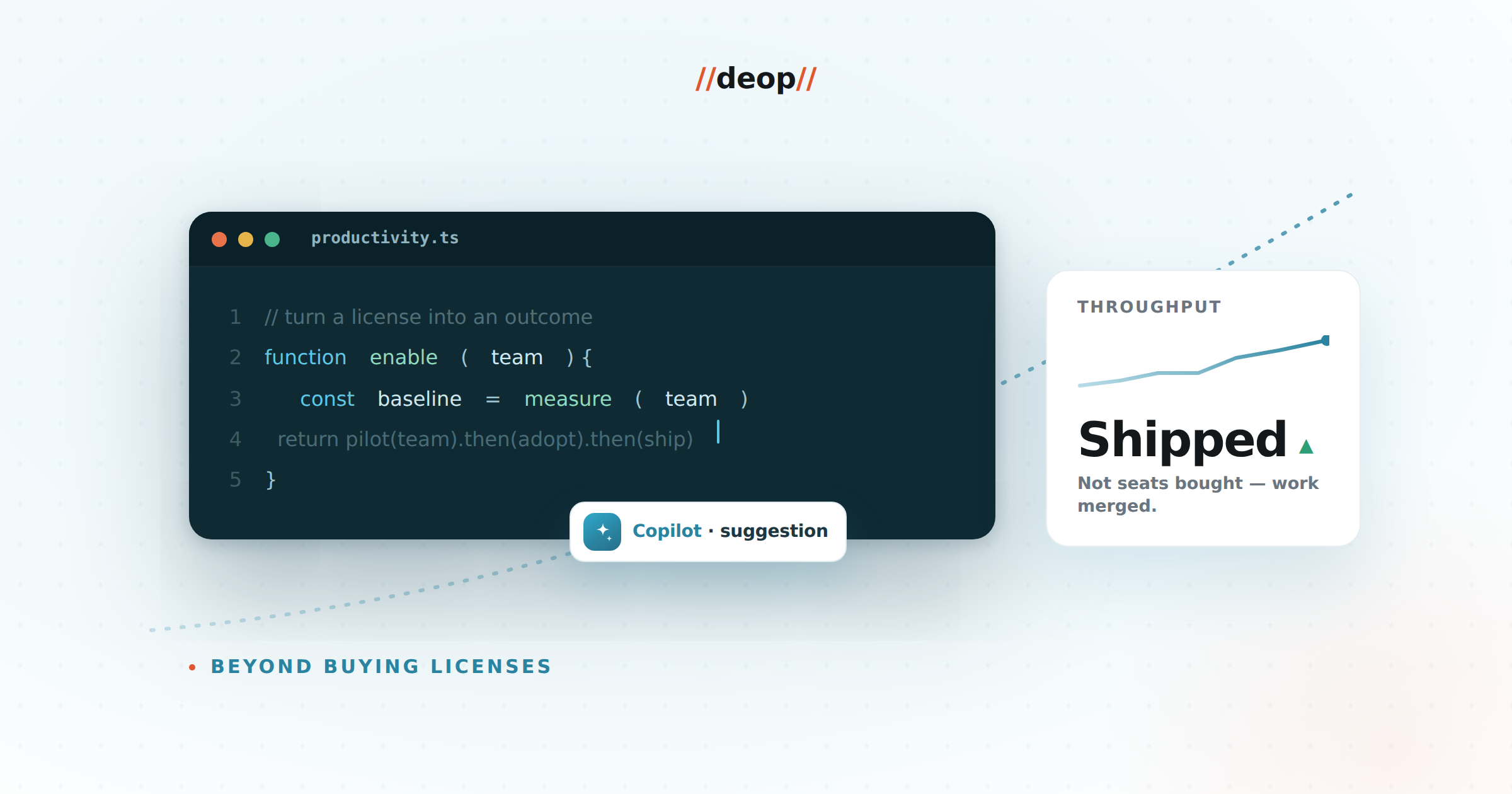
Here's a pattern we see constantly. An organization buys GitHub Copilot for its engineering teams, assigns the seats, sends an announcement, and waits for the productivity gains everyone was promised. For a couple of weeks there's a spike of curiosity. Then usage settles into a quiet plateau — a third of developers use it daily, a third occasionally, a third barely at all — and a few months later someone in a budget review asks whether it's actually doing anything. The honest answer is usually "we don't know," because nobody measured, and the tool gets a reputation for being overhyped.
The tool isn't the problem. Copilot is genuinely good. The problem is that buying licenses and getting productivity are two different projects, and most organizations only run the first one. A license gives a developer access. It doesn't teach them where the tool helps, doesn't change the habits built over years of working without it, doesn't establish whether it's safe to use on sensitive code, and doesn't tell anyone whether it worked. Those are the things that turn a purchase into a result — and they're a rollout, not a procurement.
Activation is not adoption, and adoption is not productivity
The first trap is mistaking one for the other. Three different numbers get quietly conflated:
- Activation — seats assigned. This is what you bought. It says nothing about use.
- Adoption — developers actually using the tool as part of their daily work.
- Productivity — that usage translating into work shipped faster or with less toil.
You can have 100% activation and near-zero productivity, and many organizations do. Each gap between these three has its own cause: activation-to-adoption fails because people don't know how to fit the tool into their workflow; adoption-to-productivity fails because they use it for the wrong things, or because nobody set up a way to tell whether the shipped-work needle actually moved. Closing those gaps is the whole job, and it's what the rest of this piece is about.
Start by measuring what you have
You can't prove Copilot helped if you never wrote down what "before" looked like. So the first step, before enablement even begins, is a baseline: how long does it take work to move from started to merged, how much of a developer's week goes to boilerplate and tests and glue code, how long before a new hire makes a meaningful contribution, how developers themselves rate the friction in their day.
This baseline does two things. It gives you an honest yardstick to measure against later, and — more immediately — it tells you where Copilot is actually likely to help this organization, which is rarely a guess worth making blind. Teams drowning in test-writing and repetitive scaffolding have a different opportunity than teams whose bottleneck is code review or unfamiliar legacy code. Both are Copilot opportunities; they're just different ones, and you enable them differently.
Run a structured pilot, not an open launch
Handing the whole org a new tool at once means everyone learns it alone, badly, at the same time. A better approach is a deliberate pilot: a few teams chosen because their work plays to the tool's strengths and because they'll give real feedback, run for a defined window with the baseline measured going in.
The pilot isn't just a smaller launch — it's where you learn the specific patterns that work in your codebase and your stack, so that when you scale, you're spreading proven practice instead of hope. It also produces internal proof and internal advocates, which matter more than any vendor benchmark when you're asking the next fifty developers to change how they work.
Enable the workflows, not just the feature
The difference between a developer who gets a little out of Copilot and one who gets a lot is almost never talent — it's knowing where to point it. Effective enablement is concrete about that:
- Where it shines: generating tests, scaffolding and boilerplate, explaining unfamiliar code, translating between languages or frameworks, drafting documentation, and getting un-stuck on syntax in a language you don't use often. These are the wins that compound daily.
- Where to be careful: complex business logic, security-sensitive code, and anything where a confident-but-wrong suggestion is expensive. The skill is knowing when to accept, when to edit, and when to ignore — Copilot drafts, the developer decides.
- How to prompt: the quality of what you get back depends on context. Good comments, clear function names, and an open related file change the output dramatically. This is teachable in an afternoon and most developers never get taught it.
A license gives a developer the tool. Enablement gives them the judgment about when to trust it — and that judgment is where the productivity actually lives.
Put guardrails in before you scale, not after
Developers won't lean on a tool they're unsure they're allowed to use, and leadership shouldn't want them to. So the safe-to-use questions need clear answers early: what code the tool can and can't be used on, how intellectual property and secrets are protected, how it fits organizational security and compliance requirements. Getting this settled up front removes the hesitation that quietly caps adoption, and it's the same governance discipline that carries AI across the whole AI SDLC, from experiment to everyday use. Handled well, guardrails don't slow adoption — they're what allows people to adopt without looking over their shoulder.
Measure honestly — and beware the vanity metrics
When it's time to prove the return, the temptation is to reach for the numbers that are easy to pull: suggestions accepted, lines of code generated. Resist them. Lines of code has never been a measure of value, and "acceptance rate" tells you the tool is agreeable, not that the work got better. Optimizing for those produces more code, not more progress.
The signals worth tracking are the ones tied to actual outcomes: how cycle time moved against the baseline, whether throughput improved without quality slipping, how much faster new hires reach productivity, and — not to be underrated — how developers say their work feels, because time reclaimed from drudgery and spent on real problems is a genuine result even when it's harder to put in a chart. Measure these against the baseline you captured, report them honestly including where the gains were modest, and you'll build something more valuable than a good-looking slide: a decision you can actually trust about where to invest next.
The license is the door, not the room
Copilot can meaningfully change how an engineering organization works — less time lost to repetitive work, faster onboarding, more attention left for the architecture and product decisions that actually need a human. But none of that is in the license. It's in the rollout: the baseline that tells you where to aim, the pilot that finds what works, the enablement that teaches judgment, the guardrails that make it safe, and the honest measurement that tells you whether it's working and where to push next.
Buying the seats is the easy part, and it's where most organizations stop. The ones that get real productivity treat the purchase as the starting line — and run the program that turns access into results. Copilot is also only step one: the same discipline is what carries a team into the agentic SDLC, where agents take whole issues instead of suggesting lines.
Deop helps engineering organizations turn Copilot licenses into measurable developer productivity — with structured pilots, enablement, governance, and honest measurement. Explore our Copilot enablement work or see how we did it for a codebase of hundreds of repos.