

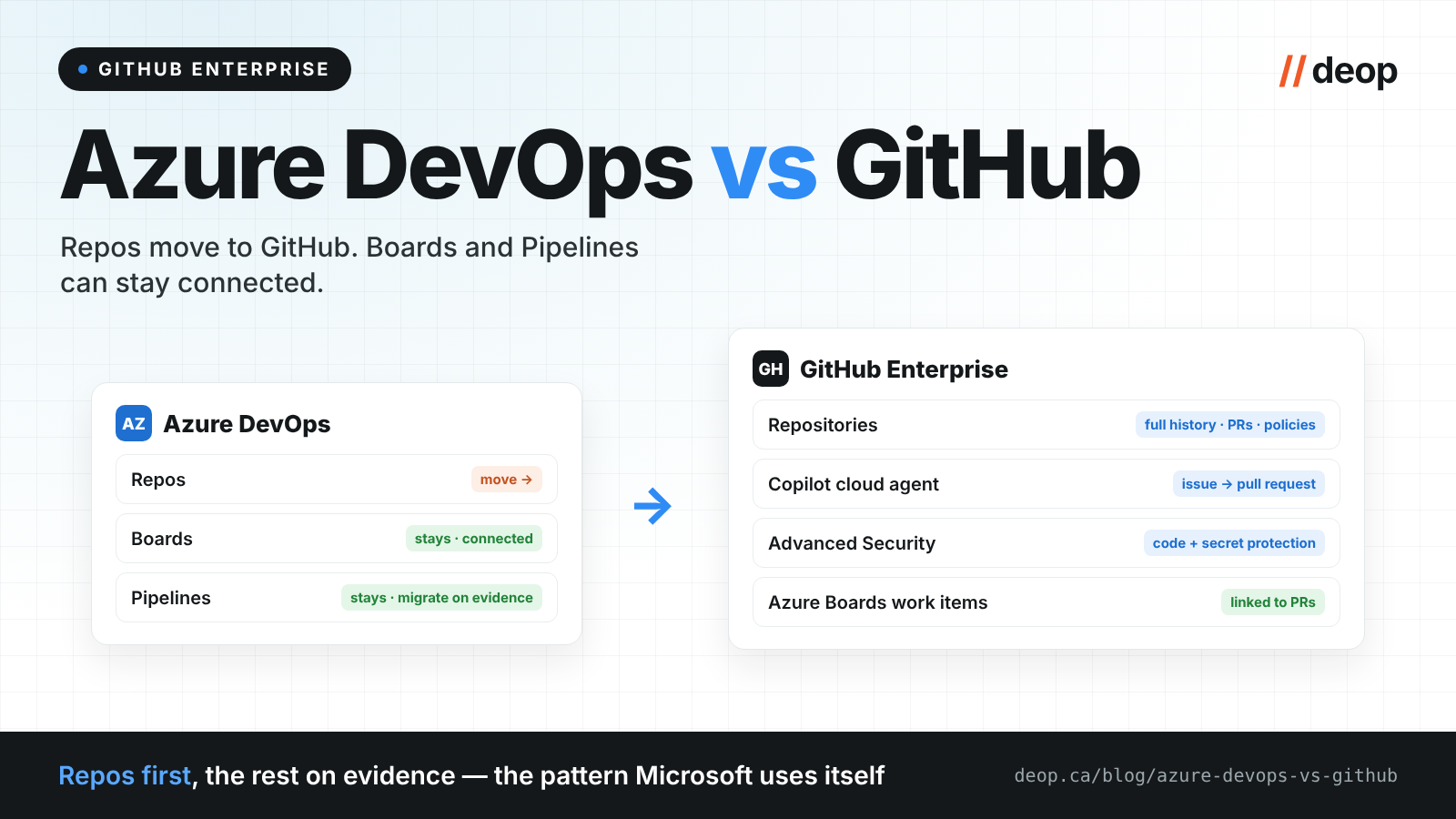
“Should we move from Azure DevOps to GitHub?” is the question we're asked most often by Microsoft-centric engineering teams — usually right after someone reads a headline declaring Azure DevOps dead. It isn't dead. But Microsoft's own guidance has shifted decisively, and in 2026 the gap between the two platforms is no longer about features you can compare in a table. It's about where Microsoft is putting its AI investment. Here's the honest picture from a team that migrates estates in both directions of this decision for a living.
What Microsoft is actually saying
Start with the primary sources, because the rumour mill runs ahead of them. Azure DevOps has an active public roadmap with features planned into 2027 — Copilot code review for Azure Repos, a remote Azure DevOps MCP server, new Test Plans capabilities (Azure DevOps roadmap). There is no retirement date.
At the same time, the Azure DevOps team's own blog has been unusually direct. In May 2025 it said: “Now is the time to migrate your Azure DevOps repositories to GitHub” — while “still benefiting from your existing investments in Azure Boards and Pipelines,” and noting that areas like Test Plans remain under ongoing investment (Azure DevOps blog). In June 2026 Microsoft followed up describing its own internal move: GitHub repositories are “key to unlocking the latest AI and agentic capabilities,” and one internal organization moved more than 80% of its in-scope repositories in about six months — keeping Boards and Pipelines where they were.
Read together, the message is precise: repositories belong on GitHub; Boards, Pipelines and Test Plans are still supported and still developed. That's narrower than “Azure DevOps is going away,” and much more useful for planning.
Where the AI gap actually is
This is the part that changes the calculation. GitHub Copilot's coding agent — assign it an issue, get a pull request back — works against code hosted on GitHub. Azure Boards gained an integration with it in late 2025: send a work item to the agent and it opens a draft pull request linked back to the item. But Microsoft's documentation is explicit that your code repositories must reside in GitHub for it to work; Azure Repos aren't supported for that integration (Microsoft Learn). Azure Repos is getting Copilot code review (in preview), but the agentic workflow — the thing driving most of the productivity conversation in 2026 — runs on GitHub.
If your organization plans to adopt agentic development in the next two years, that single fact usually decides the repository question on its own.
Side by side
- Repositories: both are solid Git hosts. GitHub gets the agentic features, GitHub Advanced Security natively, and the larger ecosystem; Azure Repos gets Copilot code review (preview).
- CI/CD: Azure Pipelines remains mature — especially for complex classic release flows — and works with GitHub repos. GitHub Actions has the bigger marketplace and is where new automation patterns appear first.
- Planning: Azure Boards is still the stronger enterprise work-tracking tool for many organizations, and it integrates with GitHub repos and with Copilot's coding agent. GitHub Issues and Projects suit teams that want planning next to the code.
- Testing: Azure Test Plans has no direct GitHub equivalent and remains a reason some teams keep Azure DevOps.
- Security: GitHub Advanced Security is available on both platforms, now split into Code Security ($30) and Secret Protection ($19) per active committer per month.
Pricing, side by side
Azure DevOps (pricing): the first five users are free, then Basic is US$6 per user per month; Basic + Test Plans is $52. One Microsoft-hosted parallel job with 1,800 minutes a month is free, and additional hosted jobs are $40 a month each. Visual Studio subscribers get access at no extra cost.
GitHub (pricing): Team is $4 and Enterprise starts at $21 per user per month — both now listed with a first-twelve-months qualifier, so confirm renewal pricing before a business case depends on it. Enterprise includes 50,000 Actions minutes a month. We broke down the full stack, including Copilot and security, in our GitHub Enterprise pricing guide.
One detail that matters for hybrids: GitHub Enterprise Cloud customers who manage users with Microsoft Entra ID get Azure DevOps Basic access at no additional cost — so keeping Boards or Pipelines after moving repos doesn't have to mean paying twice.
The pattern we recommend: repos first, the rest on evidence
For most Microsoft-centric organizations the right move isn't a big-bang platform switch. It's the pattern Microsoft uses internally:
1. Move repositories to GitHub. GitHub Enterprise Importer migrates Git source with full history, pull requests, work-item links, attachments and branch policies from Azure DevOps Services (GitHub docs). It doesn't move work items, wikis or pipelines — and it can rewire existing Azure Pipelines and Boards integrations to point at the new GitHub repos, so builds and traceability keep working on day one. Git LFS objects and Azure DevOps Server (on-premises) sources need extra steps.
2. Keep Boards and Pipelines connected. Both integrate fully with GitHub repos. Nothing forces you to migrate planning or CI on the same weekend as code.
3. Move pipelines to Actions where it pays. GitHub Actions Importer converts much of an Azure Pipelines definition automatically, but approvals, deployment gates, some triggers, service connections and secrets need hand work. Migrate pipeline by pipeline, starting with the simple ones, rather than as a single project.
4. Decide about Boards and Test Plans last. If Boards works for your organization, it now plugs into Copilot's coding agent — there may be no reason to move it at all.
When staying on Azure DevOps is the right call
It's a legitimate choice if you depend heavily on Test Plans, run complex classic release pipelines with regulated approval gates, have no near-term plan for AI coding agents, or run Azure DevOps Server on-premises with constraints GitHub Enterprise Server doesn't solve. Just make it an explicit decision with a review date — not a default — because the platform you stay on is no longer where the agentic roadmap lands.
Deop migrates Azure DevOps, GitLab and Bitbucket estates to GitHub Enterprise — repos, pipelines and governance — as a GitHub partner and Microsoft partner specialized in Agentic DevOps. See our GitHub Enterprise migration service or book a discovery.